
Instantly calculate your Body Mass Index (BMI) to understand your weight category and health risks. The CalcGami.com BMI Calculator offers a quick, accurate way to check if you are in a healthy weight range based on your height and weight.
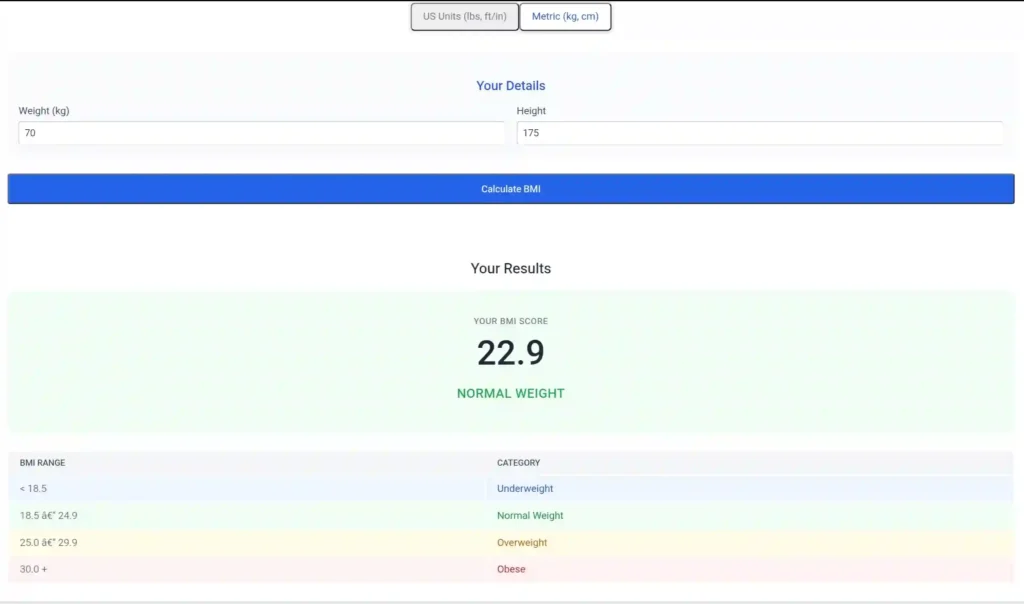
Your Results
Your BMI Score
0.0
Category
| BMI Range | Category |
|---|---|
| < 18.5 | Underweight |
| 18.5 – 24.9 | Normal Weight |
| 25.0 – 29.9 | Overweight |
| 30.0 + | Obese |
Table of Contents
What is a BMI Calculator?
A BMI Calculator is a widely used health screening tool that estimates a person’s body fat based on two specific variables: height and weight. BMI stands for Body Mass Index. It provides a simple, numeric value that categorizes individuals into different weight groups, such as underweight, normal weight, overweight, or obese.
While BMI does not measure body fat directly (like a caliper or DEXA scan would), it is recognized by the World Health Organization (WHO) and medical professionals globally as a reliable indicator of potential health risks.
It serves as a preliminary checkpoint to help individuals determine if their weight might be contributing to health issues such as heart disease, high blood pressure, or type 2 diabetes. By converting complex physical data into a single number, this BMI Calculator gives you an immediate snapshot of where you stand in relation to general health standards.
Benefits of Using a BMI Calculator
Monitoring your BMI is one of the easiest ways to stay proactive about your long-term health. Using this BMI Calculator offers several key advantages:
- Health Screening: It serves as an early warning system. A high BMI can signal the need for lifestyle changes before serious medical conditions develop.
- Objective Tracking: Weight fluctuates daily, but BMI gives a standardized metric. It helps you track progress objectively during a weight loss or weight gain journey.
- Risk Assessment: Medical research has established strong links between specific BMI ranges and chronic diseases. Knowing your number helps you understand your personal risk profile.
- Goal Setting: If you are trying to reach a “healthy weight,” the BMI Calculator provides a concrete target range to aim for, rather than just a vague number on a scale.
- Universal Standard: Because BMI is a globally standardized metric, it allows you to communicate effectively with doctors, nutritionists, and fitness trainers about your health status.
Formula Used in BMI Calculator
The mathematics behind Body Mass Index is relatively simple, but the formula changes slightly depending on whether you are using the Metric system (kilograms and meters) or the Imperial system (pounds and inches).
1. Metric System Formula
This is the standard scientific calculation used by the WHO.
- Formula: BMI = Weight (kg) / (Height (m) x Height (m))
- Explanation: You divide your weight in kilograms by the square of your height in meters.
2. Imperial System Formula
This formula includes a conversion factor (703) to align pounds and inches with the metric standard.
- Formula: BMI = (Weight (lbs) / (Height (in) x Height (in))) x 703
- Explanation: You divide your weight in pounds by the square of your height in inches, and then multiply the result by 703.
3. Understanding the Categories
Once the number is calculated, it falls into a standard range:
- Underweight: Less than 18.5
- Normal Weight: 18.5 to 24.9
- Overweight: 25 to 29.9
- Obesity: 30 or greater
How to Use the BMI Calculator
Follow these simple steps to determine your Body Mass Index:
- Select Your Unit System: Choose between “Metric” (Kilograms/Centimeters) or “Imperial” (Pounds/Feet & Inches).
- Enter Your Weight: Input your current weight accurately. It is best to weigh yourself in the morning before eating for the most precise number.
- Enter Your Height: Input your height.
- If using feet and inches, ensure you enter both fields (e.g., 5 ft and 9 in).
- Calculate: Click the button to generate your BMI score.
- Review Your Category: Look at the result to see which range you fall into (Underweight, Healthy, Overweight, or Obese) and read the corresponding health advice.
How to Use the BMI Calculator
Scenario: “John” wants to know if he is in a healthy weight range. He lives in the United States and uses the Imperial system.
The Details:
- Height: 5 feet 10 inches.
- Weight: 185 pounds.
The Calculation:
Step 1: Convert Height to Inches
First, we must convert 5 feet 10 inches entirely into inches.
(5 feet x 12 inches) + 10 inches = 70 inches.
Step 2: Square the Height
Multiply the height in inches by itself.
70 x 70 = 4,900.
Step 3: Divide Weight by Height Squared
Divide the weight (185) by the squared height (4,900).
185 / 4,900 = 0.037755.
Step 4: Apply Conversion Factor
Multiply that result by the conversion factor of 703.
0.037755 x 703 = 26.54.
The Result:
John’s BMI is 26.5.
Interpretation: Looking at the standard categories, a BMI of 26.5 falls into the Overweight range (25.0 – 29.9). This suggests John might benefit from slight weight loss to lower his risk of future health issues, although he is very close to the “Normal” range.
Frequently Asked Questions (FAQ)
Is BMI accurate for athletes or bodybuilders?
No, BMI is often inaccurate for people with high muscle mass. Muscle is much denser than fat. A bodybuilder may weigh a lot relative to their height, resulting in a high BMI that classifies them as “Obese,” even though they have very low body fat and are extremely healthy. In these cases, body fat percentage measurements are more appropriate.
Does BMI differ for men and women?
The standard formula for calculating BMI is the same for adult men and women. However, the interpretation of health risks can vary slightly because women naturally have more body fat than men. Despite this, the standard categories (Underweight, Normal, Overweight, Obese) are applied universally to both genders in most general screenings.
At what age can I start using this calculator?
This standard BMI calculator is designed for adults (18 years and older). For children and teenagers (ages 2 to 19), BMI must be interpreted differently using “Growth Charts” that compare the child to others of the same age and gender (percentiles). A child’s BMI changes rapidly as they grow, so a standard adult BMI Calculator should not be used for them.
Why is my BMI “Normal” but I still feel like I have too much fat?
This is a condition often called “Skinny Fat” or normal-weight obesity. It is possible to have a normal BMI score but still have a high percentage of body fat and low muscle mass. This can still carry health risks similar to being overweight. BMI focuses on mass, not composition.
What are the health risks of having a high BMI?
Being in the Overweight or Obese categories is statistically linked to a higher risk of several chronic conditions, including Type 2 Diabetes, High Blood Pressure (Hypertension), Cardiovascular disease, Gallstones, and Sleep Apnea. Lowering your BMI by even a few points can significantly reduce these risks.
Is BMI the only way to measure health?
No. BMI is a screening tool, not a diagnostic one. It should be used alongside other measurements like Waist Circumference (to check for abdominal fat), Blood Pressure, Cholesterol levels, and Blood Sugar levels. A doctor will look at the “big picture” of your health rather than relying on BMI alone.