
Calculate the exact volume of concrete and number of bags needed for your project. The CalcGami.com, Concrete Calculator helps you estimate cubic yards for slabs, footings, and post holes to prevent waste and save money.
Required Volume
Cubic Yards
0
Standard truck unit
Cubic Feet
0
Volume
Pre-Mix Bags Needed
0
80lb Bags
0
60lb Bags
*Bag counts are estimates based on standard yields.
Table of Contents
What is a Concrete Calculator?
A Concrete Calculator is a construction estimation tool designed to help contractors and DIY enthusiasts determine the precise volume of concrete required to fill a specific space. Whether you are pouring a driveway, building a patio, or setting fence posts, knowing the exact amount of material is crucial.Concrete is typically sold by volume (Cubic Yards or Cubic Meters) rather than weight. However, calculating this volume can be tricky because most project measurements are taken in linear units like feet, inches, or meters. A concrete calculator automates the conversion of these linear dimensions into total volume. It also helps you calculate how many pre-mixed bags (e.g., 40lb, 60lb, or 80lb bags) you need to buy if you are mixing the concrete yourself by hand.
Benefits of Using a Concrete Calculator
Pouring concrete is a time-sensitive and expensive task. Using a Concrete calculator provides several key advantages:
- Prevent Shortages: Running out of wet concrete halfway through a pour is a disaster that can ruin the structural integrity of your project. This tool ensures you order enough.
- Cost Efficiency: Ready-mix trucks often charge “short load fees” for small orders, and buying too many bags is a waste of money. Accurate calculation keeps your budget tight.
- Wastage Buffer: Professional estimators always add a safety margin for spillage and uneven ground. The calculator allows you to easily factor in this “wastage” percentage.
- Multi-Shape Support: It handles not just rectangular slabs but also cylindrical shapes like post holes and concrete tubes (sonotubes), which require complex math.
- Bag Conversion: Instantly translates “Cubic Yards” into the exact number of bags you need to pick up from the hardware store.
Formula Used in Concrete Calculator
The calculator uses standard geometric volume formulas to determine the cubic yardage.
1. For Rectangular Slabs (Driveways, Patios, Footings)
The formula calculates the volume of a box.
- Step 1: Convert all dimensions to Feet.
- Step 2: Calculate Cubic Feet.
Formula: Volume (cu ft) = Length (ft) x Width (ft) x Thickness (ft) - Step 3: Convert to Cubic Yards.
Formula: Volume (cu yds) = Volume (cu ft) / 27
2. For Cylinders (Post Holes, Columns)
The formula calculates the volume of a cylinder.
- Step 1: Determine the Radius (half of the diameter) in Feet.
- Step 2: Calculate Cubic Feet.
Formula: Volume (cu ft) = 3.1416 x Radius (ft) x Radius (ft) x Depth (ft) - Step 3: Convert to Cubic Yards.
Formula: Volume (cu yds) = Volume (cu ft) / 27
3. Calculating Pre-Mix Bags
If buying bags, the total Cubic Yards is divided by the yield of a single bag.
- 80lb Bag: Yields approx 0.60 cubic feet.
- 60lb Bag: Yields approx 0.45 cubic feet.
- 40lb Bag: Yields approx 0.30 cubic feet.
How to Use the Concrete Calculator
Follow these steps to get an accurate material list:
- Select Shape: Choose “Slab / Square” for driveways or “Hole / Column” for fence posts.
- Measure Dimensions:
- For Slabs: Enter Length, Width, and Thickness.
- For Columns: Enter Diameter and Depth/Height.
- Select Units: Ensure you select the correct unit for each input (e.g., Feet for length, Inches for thickness).
- Set Quantity: If you are pouring multiple identical holes or slabs, enter the quantity.
- Calculate: Click the button to see the Total Cubic Yards.
- Check Bag Count: Look at the results to see how many 60lb or 80lb bags are required for that volume.
How to Use the Concrete Calculator
Follow these steps to get an accurate material list:
- Select Shape: Choose “Slab / Square” for driveways or “Hole / Column” for fence posts.
- Measure Dimensions:
- For Slabs: Enter Length, Width, and Thickness.
- For Columns: Enter Diameter and Depth/Height.
- Select Units: Ensure you select the correct unit for each input (e.g., Feet for length, Inches for thickness).
- Set Quantity: If you are pouring multiple identical holes or slabs, enter the quantity.
- Calculate: Click the button to see the Total Cubic Yards.
- Check Bag Count: Look at the results to see how many 60lb or 80lb bags are required for that volume.
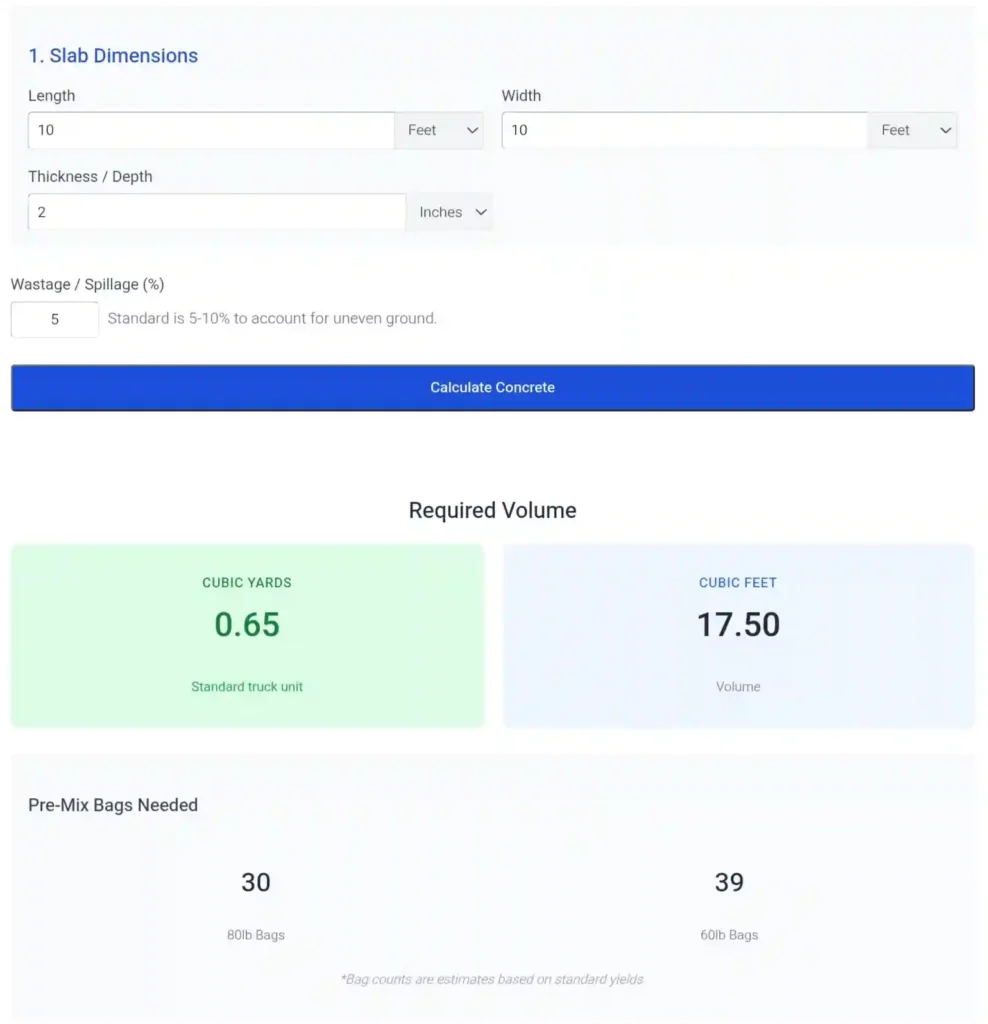
Real-Life Example
Scenario: You are building a rectangular patio in your backyard.
- Length: 12 feet.
- Width: 10 feet.
- Thickness: 4 inches (standard patio thickness).
Step 1: Convert Thickness to Feet
Since length and width are in feet, we convert 4 inches to feet.
4 inches / 12 = 0.33 feet.
Step 2: Calculate Volume in Cubic Feet
12 ft (Length) x 10 ft (Width) x 0.33 ft (Thickness) = 39.6 Cubic Feet.
Step 3: Convert to Cubic Yards
39.6 / 27 = 1.47 Cubic Yards.
Step 4: Add Wastage (Safe Margin)
It is standard to add 10% for spillage or uneven sub-base.
1.47 x 1.10 = 1.62 Cubic Yards.
Result: You should order 1.75 Cubic Yards from a ready-mix supplier (they usually sell in quarter-yard increments).
Alternatively, if using 80lb bags:
39.6 cubic feet / 0.60 (yield per bag) = 66 Bags.
Frequently Asked Questions (FAQ)
How much concrete is in a “Yard”?
When contractors say “a yard,” they mean one Cubic Yard. One cubic yard is a volume of material that is 3 feet wide, 3 feet long, and 3 feet high. It is equal to 27 cubic feet. One cubic yard of concrete weighs approximately 4,000 lbs (2 tons).
How many bags of concrete do I need for 1 yard?
To make 1 Cubic Yard of concrete, you will need approximately:
45 bags of 80lb mix.
60 bags of 60lb mix.
90 bags of 40lb mix.
Should I mix it myself or order a truck?
As a general rule, if your project requires more than 1 Cubic Yard (approx 45-50 bags), it is usually easier and often cheaper to order “Ready-Mix” concrete delivered by a truck. Mixing 50+ bags by hand is extremely labor-intensive and difficult to finish before the concrete starts to set.
How thick should my concrete slab be?
4 Inches: Standard for walkways, patios, and residential driveways (passenger cars).
5-6 Inches: Recommended for heavy-duty driveways (trucks/SUVs) or hot tub pads.
8+ Inches: Required for heavy industrial loads.
What is the difference between Concrete and Cement?
They are not the same thing. Cement is an ingredient (a grey powder) that acts as the glue. Concrete is the finished building material made by mixing Cement, Sand, and Gravel (Aggregate) with water.
Why do I need to add “Wastage”?
The ground is rarely perfectly flat. If your ground is slightly uneven, or if your wooden forms bow out slightly under the weight of the concrete, you will need more material than the perfect mathematical calculation suggests. Adding 5-10% extra prevents you from running short.