
Accelerate your journey to debt freedom with the CalcGami Student Loan Payoff Calculator 2026. Estimate your monthly payments, total interest costs, and debt-free date for Federal and Private loans. Save payoff strategies and share your financial goals via WhatsApp.
Estimated Debt-Free Date
--/--
Add your loans to see your timeline
Total Interest Paid
$0.00
Months to Pay Off
0
Saved Projections
| Date | Total Debt | Payoff Date |
|---|
Table of Contents
What is a Student Loan Payoff Calculator?
A Student Loan Payoff Calculator is a specialized financial planning tool designed to help graduates and students navigate the complex world of educational debt. As we move into 2026, the landscape of American student loans has shifted, with new repayment plans, fluctuating interest rates, and evolving federal policies like the SAVE Plan and various forgiveness programs.
Managing student debt is a long-term commitment that requires more than just making the minimum monthly payment. This calculator allows you to visualize the “finish line” of your debt. By entering your Current Loan Balance, Annual Interest Rate, and Monthly Payment Amount, the tool calculates exactly how many months it will take to reach a zero balance. It also reveals the total interest you will pay over the life of the loan. Whether you are managing undergraduate Stafford loans, Grad PLUS loans, or high-interest private bank loans, this calculator provides the data you need to reclaim your financial future. It features History to track different loan groups, Save Calculation to log your progress, and WhatsApp Share to discuss payoff strategies with a financial coach or family.
Benefits of Using a Student Loan Payoff Calculator
In the 2026 economy, proactive debt management is the key to achieving major life milestones like buying a home or starting a family. This tool offers several strategic advantages:
- Visualize the “Debt-Free” Date: Most borrowers feel overwhelmed by a large balance. This tool gives you a specific month and year when you will be free, providing a powerful psychological boost.
- The Impact of Extra Payments: See exactly how much time and money you save by adding even an extra $50 or $100 to your monthly payment. This is often more effective than traditional savings accounts for long-term wealth building.
- Avalanche vs. Snowball Strategy: If you have multiple loans, use Save Calculation to list each one. This helps you decide whether to pay off the highest interest rate first (Avalanche) or the smallest balance first (Snowball).
- Federal vs. Private Loan Comparison: Interest rates on federal loans are fixed, but private loans can be variable. This tool helps you see if refinancing your private loans into a lower fixed rate in 2026 makes financial sense.
- Budgeting for the SAVE Plan: For those on Income-Driven Repayment (IDR) plans like SAVE, use this tool to see if your required payment is covering the interest or if your balance is staying stagnant.
- Tax Planning: In the USA, you can often deduct up to $2,500 in student loan interest from your taxable income. Use the “Total Interest” result to estimate your potential tax benefits.
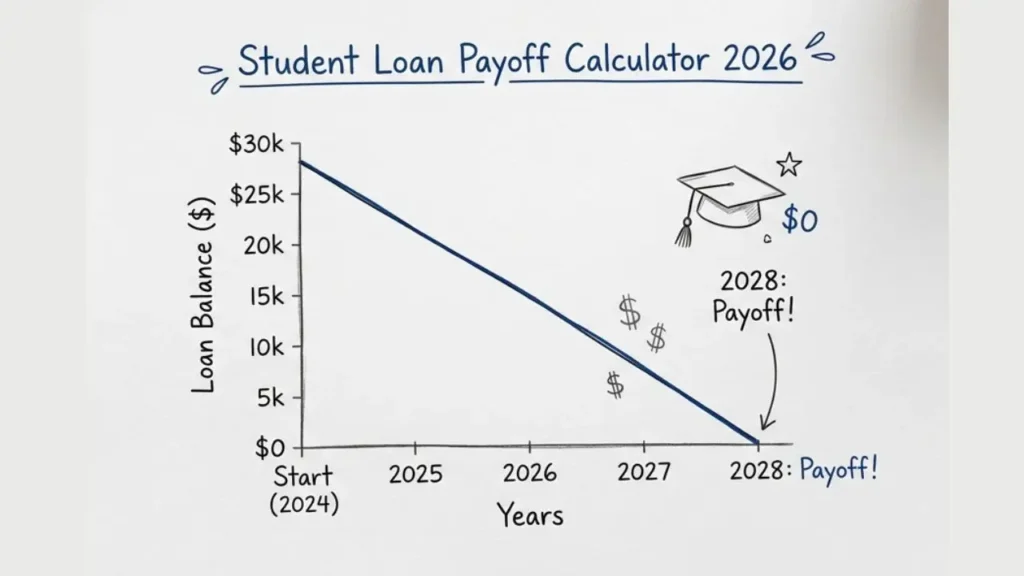
Formula Used in Student Loan Payoff Calculator
The calculator utilizes the standard loan amortization formula to solve for the “Number of Periods” (n).
Formulas:
- Calculate Number of Months to Payoff:
Formula: n = -log(1 – (r * P) / M) / log(1 + r)- Where: P = Loan Balance, M = Monthly Payment, r = Monthly Interest Rate.
- Total Interest Paid:
Formula: (Monthly Payment x Months to Payoff) – Original Balance = Total Interest
How to Use the Student Loan Payoff Calculator
Follow these steps to take control of your student debt:
- Enter Loan Balance: Input the total amount you currently owe (including any accrued interest).
- Enter Interest Rate: Input the annual interest rate for the loan (e.g., 5.28% for Federal undergrad loans).
- Enter Monthly Payment: Input how much you plan to pay each month.
- Calculate: View your payoff timeline and total interest cost.
- Use Productivity Features:
- History: Compare your payoff date with a $300 payment vs. a $500 payment.
- Save Calculation: Store as “Federal Subsidized Loan – Group A.”
- Share on WhatsApp: Send: “I’ll be officially debt-free in October 2029!”
Real-Life Example
The Scenario:
Imagine you have a 30,000 student loan balance in 2026. Your interest rate is 6% 333 per month. You want to see how much faster you finish if you pay $500 per month instead.
The Details:
- Current Balance: $30,000
- Interest Rate: 6%
- Current Payment: $333 (10-year plan)
- Target Payment: $500
The Calculation:
- At 333/mo: You finish in 120months (10 years). Total Interest: 9,960.
- At 500/mo: You finish in 71 months (approx 6 years).Total Interest: 5,650.
The Result:
By paying 500, you save4,310 in interest** and finish 4 years earlier.
Action: You save this as “Accelerated Payoff Plan” and use WhatsApp Share to tell your partner you are committing to the $500 payment to save over $4,000.
Frequently Asked Questions (FAQ)
How do I find my current interest rate and balance?
For Federal loans in the USA, you should log in to your account at StudentAid.gov. For private loans, check your latest monthly statement from lenders like SoFi, Sallie Mae, or Earnest.
Is there a “Grace Period” in 2026?
Typically, Federal loans have a 6-month grace period after graduation before payments are required. However, interest often continues to accrue during this time. Use the calculator to see how much your balance will grow if you don’t make interest-only payments during the grace period.
What is the “SAVE Plan” and how does it affect my payoff?
The Saving on a Valuable Education (SAVE) plan is an income-driven repayment plan. It can lower your monthly payment to $0 if your income is below a certain threshold and prevents your balance from growing due to unpaid interest. If you are on SAVE, your payoff date may be longer, but your monthly burden is lower.
Should I prioritize my student loans or my credit card debt?
Generally, you should pay the minimum on your student loans and put any extra cash toward your credit card debt first, as credit cards usually have much higher interest rates (20%+ vs. 6%).
Can I use this for Parent PLUS loans?
Yes. Parent PLUS loans often have higher interest rates than student loans. Using this calculator is vital for parents to see if they can pay off the debt before they reach retirement age.
What does it mean to “Refinance” a student loan?
Refinancing involves taking out a new loan with a private lender to pay off your old ones, ideally at a lower interest rate. If you have a high credit score in 2026, refinancing can save you thousands, but be careful: refinancing Federal loans into Private loans means you lose federal protections and forgiveness options.
Is student loan interest tax-deductible in 2026?
As of current US tax law, you can deduct up to $2,500 of interest paid on qualified student loans each year, even if you don’t itemize your deductions. This can lower your overall tax bill.
How often should I recalculate my payoff?
You should use the calculator every time you get a raise or a bonus. Applying a one-time “lump sum” payment (like a tax refund) can significantly pull your “Debt-Free Date” closer to the present.