
Discover exactly how many calories your body burns at rest with the CalcGami.com BMR Calculator. Calculate your Basal Metabolic Rate to optimize your diet, plan effective weight loss, and understand your true metabolic needs.
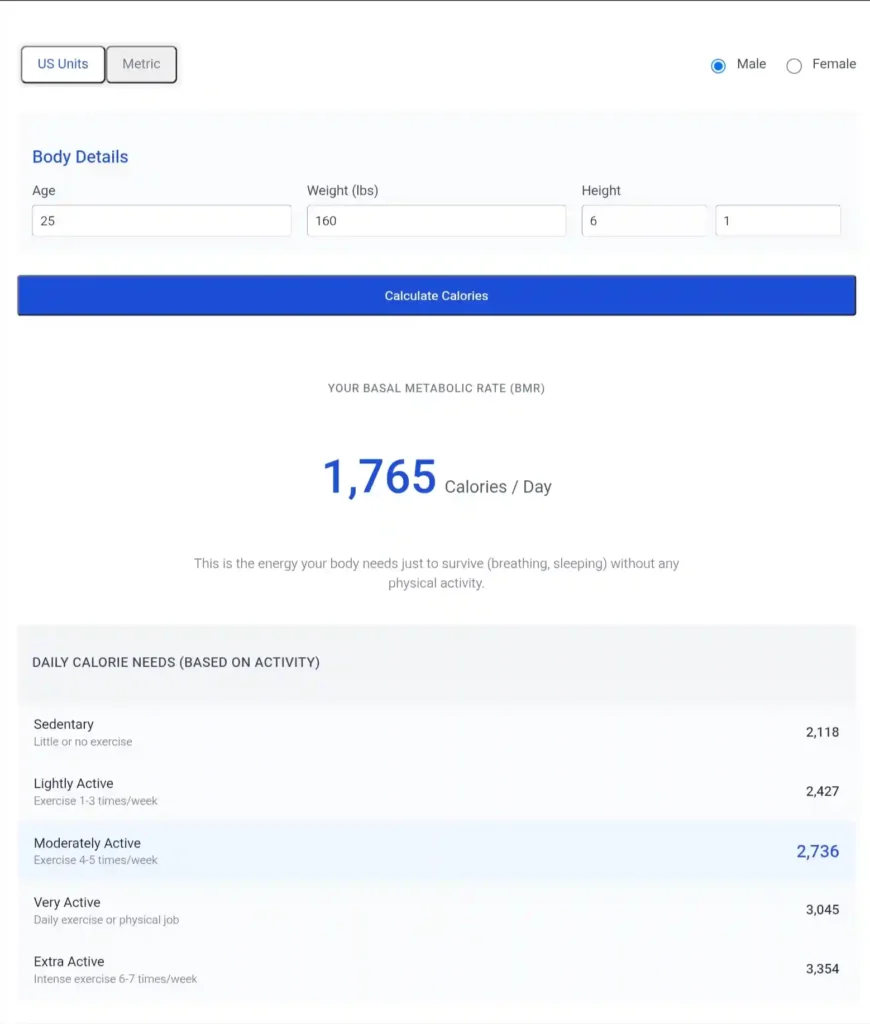
Your Basal Metabolic Rate (BMR)
0
Calories / Day
This is the energy your body needs just to survive (breathing, sleeping) without any physical activity.
Daily Calorie Needs (Based on Activity)
| Sedentary Little or no exercise | 0 |
| Lightly Active Exercise 1-3 times/week | 0 |
| Moderately Active Exercise 4-5 times/week | 0 |
| Very Active Daily exercise or physical job | 0 |
| Extra Active Intense exercise 6-7 times/week | 0 |
Table of Contents
What is a BMR Calculator?
A BMR Calculator is a nutritional tool designed to estimate your Basal Metabolic Rate. This figure represents the minimum number of calories your body requires to perform its most basic life-sustaining functions while at complete rest.
Even when you are sleeping, watching TV, or staring at the ceiling, your body is burning energy. Your heart needs to pump blood, your lungs need to inflate, your brain needs to process signals, and your cells need to regenerate. BMR accounts for roughly 60% to 75% of the total calories you burn in a day. It effectively tells you: “If you stayed in bed all day and did absolutely nothing, this is how much energy you would still burn.”
Understanding your BMR is the cornerstone of any scientifically backed weight management plan. It serves as the “baseline” number upon which you build your Total Daily Energy Expenditure (TDEE). Without knowing your BMR, guessing how many calories to eat for weight loss or muscle gain is simply shooting in the dark.
Benefits of Using a BMR Calculator
Calculating your Basal Metabolic Rate provides critical data for your health journey. Here are the detailed benefits:
- Scientific Weight Loss: To lose weight, you must be in a calorie deficit. BMR gives you the “floor” of your calorie needs. Knowing this helps you set a deficit that is effective but safe (not starving your vital organs).
- Precision Meal Planning: Instead of following a generic “2,000 calorie a day” diet, a BMR calculator customizes your intake based on your specific body composition, age, and gender.
- Understanding Metabolism: People often blame “slow metabolism” for weight gain. This BMR calculator tool gives you a concrete number to verify your metabolic rate so you can stop guessing and start managing it.
- Bulking and Muscle Gain: For athletes, eating enough is just as hard as eating less. BMR helps ensure you are consuming enough surplus energy to fuel muscle repair and growth.
- Age-Adjusted Health: As you age, your metabolic rate naturally slows down. This BMR calculator accounts for your age, helping you adjust your diet as you get older to prevent creeping weight gain.
Formula Used in BMR Calculator
The most widely accepted and accurate formula for calculating BMR today is the Mifflin-St Jeor Equation. It is considered more accurate than the older Harris-Benedict equation, as it better reflects modern lifestyles and body compositions.
The formula differs slightly for men and women because men generally have more lean muscle mass, which burns more calories at rest.
1. The Variables
- W: Weight in Kilograms (kg)
- H: Height in Centimeters (cm)
- A: Age in Years
2. Formula for Men
BMR = (10 x Weight) + (6.25 x Height) – (5 x Age) + 5
3. Formula for Women
BMR = (10 x Weight) + (6.25 x Height) – (5 x Age) – 161
4. Interpretation
The result is a number representing Calories per Day.
- Note on Units: If you measure in pounds and inches, you must convert them first:
- Pounds / 2.2046 = Kilograms
- Inches x 2.54 = Centimeters
How to Use the BMR Calculator
Follow these steps to find your baseline caloric burn:
- Select Gender: Choose Male or Female. This is crucial because it determines which mathematical constant is used in the formula.
- Enter Age: Input your current age. Metabolism slows slightly with every passing year.
- Enter Height: Input your height. Taller individuals have more surface area and tissue, leading to a higher BMR.
- Enter Weight: Input your current weight. Heavier bodies require more energy to maintain tissue.
- Calculate: Click the button to generate your BMR score.
- Next Steps (Optional): While BMR is your resting rate, most people multiply this number by an “Activity Factor” (like 1.2 for sedentary or 1.55 for active) to find their Total Daily Energy Expenditure (TDEE).
Real-Life Example
Scenario: “Sarah” is a 30-year-old woman looking to start a diet. She wants to know the absolute minimum calories her body needs before she adds any exercise.
The Details:
- Gender: Female
- Age: 30 years
- Height: 5 feet 5 inches (which converts to 165 cm)
- Weight: 150 lbs (which converts to 68 kg)
The Calculation (Mifflin-St Jeor for Women):
Step 1: Calculate Weight Component
10 x 68 (weight in kg) = 680
Step 2: Calculate Height Component
6.25 x 165 (height in cm) = 1,031.25
Step 3: Calculate Age Component
5 x 30 (age in years) = 150
Step 4: Combine Components
Formula: (Weight Comp) + (Height Comp) – (Age Comp) – 161
Math: 680 + 1,031.25 – 150 – 161
Step 5: Final Math
1,711.25 – 150 = 1,561.25
1,561.25 – 161 = 1,400.25
The Result:
Sarah’s BMR is approximately 1,400 Calories/day.
Takeaway: If Sarah lays in bed all day, she burns 1,400 calories. Therefore, she should not try to eat a diet of 1,000 calories, as that is far below her body’s basic biological needs and could damage her metabolism.
Frequently Asked Questions (FAQ)
What is the difference between BMR and BMI?
They sound similar but are totally different.
BMI (Body Mass Index): A ratio of weight to height used to diagnose obesity. It is a general health score.
BMR (Basal Metabolic Rate): A calculation of energy (calories) burned. It is a nutritional tool for diet planning.
Should I eat less than my BMR to lose weight fast?
No. Nutritionists generally recommend never eating below your BMR. Your BMR represents the energy needed for your heart, brain, and liver to function. Eating below this level puts your body into “starvation mode,” where it slows down your metabolism to survive, making long-term weight loss harder and potentially causing health issues like hair loss and fatigue.
Does muscle affect my BMR?
Yes, significantly. Muscle tissue is metabolically active, meaning it burns calories just by existing. Fat tissue burns very few calories. Two people who weigh the same amount can have different BMRs if one is muscular and the other is not. The muscular person will have a higher BMR.
How does age affect my BMR?
As you age, your BMR tends to decrease. This is partly due to hormonal changes, but largely because people tend to lose muscle mass as they get older. This is why you might find that you can’t eat the same amount of food at 40 as you did at 20 without gaining weight.
What is the difference between BMR and TDEE?
BMR: Calories burned at complete rest (Coma calories).
TDEE (Total Daily Energy Expenditure): Calories burned during your actual day, including walking, working, exercising, and digesting food. TDEE is always higher than BMR. To lose weight, you should eat less than your TDEE, but more than your BMR.
How often should I recalculate my BMR?
You should recalculate your BMR every time you lose or gain a significant amount of weight (e.g., every 5-10 lbs). As you lose weight, your body becomes smaller and requires less energy to maintain itself, meaning your BMR drops. You must adjust your calorie intake downward to continue losing weight.