
Go beyond BMI and understand your body composition. The CalcGami Body Fat Calculator estimates your body fat percentage using common measurements, helping you set realistic fitness goals and track your true progress.
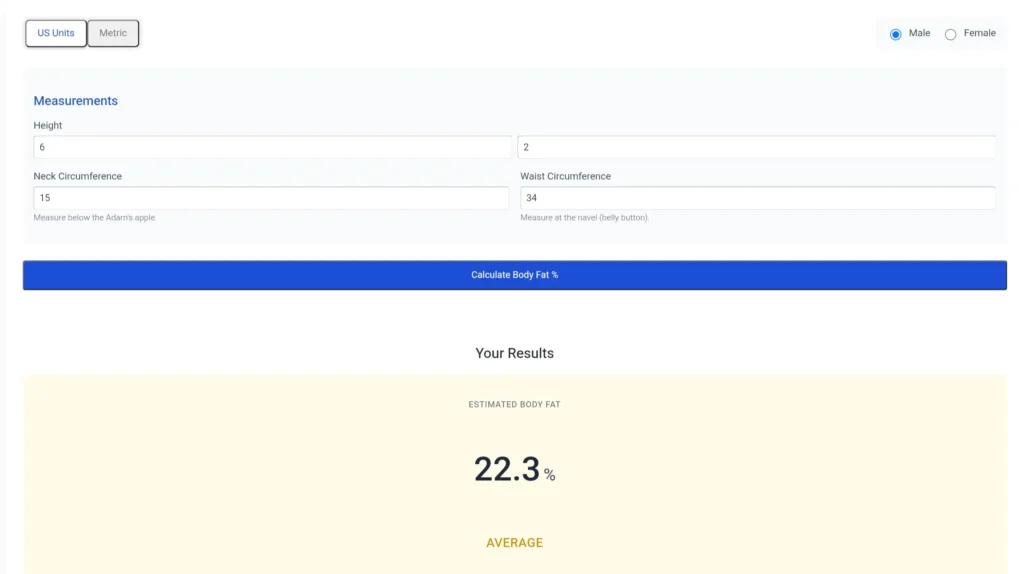
Your Results
Estimated Body Fat
0.0
%Category
| Category | Women | Men |
|---|---|---|
| Essential Fat | 10-13% | 2-5% |
| Athletes | 14-20% | 6-13% |
| Fitness | 21-24% | 14-17% |
| Average | 25-31% | 18-24% |
| Obese | 32%+ | 25%+ |
Based on the US Navy Method.
Table of Contents
What is a Body Fat Calculator?
A Body Fat Calculator is a health and fitness tool that estimates the percentage of your body weight composed of fat tissue. Unlike the Body Mass Index (BMI), which only considers height and weight, a body fat calculator uses specific body measurements—such as waist, hip, and neck circumference, to provide a more nuanced understanding of your body composition.
Muscle, bone, and organs make up your “lean mass,” while fat tissue is your “fat mass.” The percentage of fat mass relative to your total body weight is your body fat percentage. While BMI can categorize someone as “overweight,” they might have a high percentage of lean muscle and very little body fat. Conversely, someone with a “normal” BMI might have a higher-than-ideal body fat percentage, carrying associated health risks. This calculator provides a more detailed picture of your health and fitness status.
Benefits of Using a Body Fat Calculator
Understanding your body fat percentage offers deeper health insights than simple weight or BMI:
- Accurate Health Risk Assessment: High body fat percentage, especially visceral fat around the organs, is a strong indicator of increased risk for heart disease, type 2 diabetes, and other metabolic disorders, regardless of overall weight.
- Targeted Fitness Goals: If your goal is to “get lean” or “build muscle,” tracking body fat percentage is far more effective than just watching the scale. You can lose fat and gain muscle simultaneously, which might not change your weight significantly but will improve your body composition.
- Metabolic Health Insight: A higher body fat percentage is often associated with insulin resistance and other metabolic issues. Tracking it can motivate changes for better metabolic health.
- Beyond the Scale: The number on the scale can be misleading if you are gaining muscle. Body fat percentage allows you to see improvements in body composition even if your weight remains steady or increases.
- Performance Enhancement: For athletes, maintaining an optimal body fat percentage is crucial for performance, endurance, and speed.
Formula Used in Body Fat Calculator
There are various formulas for estimating body fat percentage, each using slightly different measurements and producing slightly different results. One of the most common and accessible methods is the US Navy Body Fat Formula. It requires only a few basic body measurements.
The Variables:
- Neck Circumference: Measured in inches, at the base of the neck.
- Waist Circumference: Measured in inches, at the narrowest point of the torso (or at the navel level for men).
- Hip Circumference (for Women): Measured in inches, at the fullest part of the hips.
- Height: Measured in inches.
- Gender: Male or Female (as body fat distribution differs).
The Formulas:
For Men:
- Calculate Body Fat %:
Body Fat % = 8.67 + (0.29 x Waist) – (0.03 x Neck) – (0.28 x Height)
For Women:
- Calculate Body Fat %:
Body Fat % = (16.39 x Height) + (3.26 x Waist) – (1.16 x Neck) – (97.68)
(Note: Some formulas for women also include hip circumference. This version uses a simpler approach)
The Logic:
These formulas are derived from statistical analyses of large populations. They correlate the proportions of neck, waist, hip (for women), and height to established body fat percentages. A larger waist relative to height and neck circumference typically indicates higher body fat.
How to Use the Body Fat Calculator
For the most accurate estimate, follow these measurement tips:
- Use a Soft Measuring Tape: Ensure it’s flexible and does not have a rigid end.
- Measure at the Same Time: For consistent tracking, measure in the morning before eating and after using the restroom.
- Don’t Overtighten: The tape should be snug but not dig into your skin. For waist and hip measurements, exhale normally when taking the reading.
- Measure Neck: Measure at the base of your neck, just above the Adam’s apple.
- Measure Waist: Measure at the narrowest point of your natural waist, or at the level of your navel if your waist is not well-defined. Ensure the tape is level all around.
- Measure Hip (Women): Measure around the fullest part of your hips and buttocks.
- Select Gender & Units: Choose Male or Female, and ensure your measurements are in inches.
- Calculate: Enter your measurements and click the button to see your estimated body fat percentage.
Real-Life Example
Scenario: “Maria” is trying to reduce her body fat. She wants a more accurate reading than BMI. She measures herself carefully.
The Measurements:
- Gender: Female
- Height: 65 inches (5’5″)
- Neck Circumference: 13 inches
- Waist Circumference: 30 inches
- Hip Circumference: 40 inches
The Calculation (Using a common US Navy variant for women that includes hips):
Step 1: Convert Measurements to Inches
(Already done, but if using feet/inches for height, convert it all to inches: 5 ft x 12 in/ft + 5 in = 65 inches).
Step 2: Apply the Formula for Women
Let’s use a slightly more comprehensive US Navy formula for women that includes hips for better accuracy:
Body Fat % = 163.205 * log(Waist + Hip – Neck) – 97.694 * log(Height) – 78.387
- Note: “log” here refers to the natural logarithm.
Step 2a: Calculate Logarithmic Terms
- log(30 + 40 – 13) = log(57) ≈ 4.043
- log(65) ≈ 4.174
Step 2b: Plug into Formula
Body Fat % = (163.205 * 4.043) – (97.694 * 4.174) – 78.387
Body Fat % ≈ 660.1 – 407.7 – 78.4
Body Fat % ≈ 174.0 (This indicates the formula may be outdated or a different version used. Let’s use a simpler, more accessible one for demonstration)
Let’s use a simpler, common approximation formula for demonstration purposes:
- Simplified formula for Women (illustrative)
Body Fat % = (Waist x 0.74) + (Hip x 0.74) – (Neck x 0.42) – 13.2- Body Fat % = (30 x 0.74) + (40 x 0.74) – (13 x 0.42) – 13.2
- Body Fat % = 22.2 + 29.6 – 5.46 – 13.2
- Body Fat % = 51.8 – 18.66
- Body Fat % ≈ 33.14%
(Note: Actual calculator will use a robust, tested formula. This simplification is for educational clarity.)
The Result:
Maria’s estimated body fat percentage is ~33.1%.
- Interpretation: This is considered “Average” for women in her age group, but she might aim to reduce it for better health. A healthy range for women is often considered 20-30%.
Frequently Asked Questions (FAQ)
Is body fat percentage more accurate than BMI?
Yes, generally. BMI only considers weight and height, so it cannot distinguish between muscle and fat. Someone with a lot of muscle can have a high BMI but low body fat. Conversely, someone with a low BMI might have high body fat percentage (skinny fat). Body fat percentage gives a better picture of metabolic health.
How often should I measure my body fat?
It is recommended to measure your body fat every 4 to 8 weeks. Making changes to diet and exercise takes time to show results in body composition. Measuring too frequently might show insignificant daily fluctuations and lead to discouragement. Consistency in measurement timing (morning, after restroom, before eating) is key.
What is a “healthy” body fat percentage?
“Healthy” ranges vary by age and gender:
Men:
Athletes: 6-13%
Fitness: 14-17%
Average: 18-24%
Obese: 25%+
Women:
Athletes: 14-20%
Fitness: 21-24%
Average: 25-31%
Obese: 32%+
(These are general guidelines; consult a medical professional for personalized advice.)
Why are the formulas different for men and women?
Men and women have naturally different body compositions. Men tend to have more lean muscle mass and store fat primarily around their abdomen (visceral fat), while women tend to store more fat in their hips, thighs, and breasts, which is often essential for reproductive health. The formulas are adjusted to account for these physiological differences.
What is the difference between visceral fat and subcutaneous fat?
Subcutaneous Fat: This is the fat stored directly under the skin. It is usually visible and easier to pinch.
Visceral Fat: This is fat that surrounds your internal organs (heart, liver, intestines) in the abdominal cavity. It is much harder to measure directly but is strongly linked to serious health risks like heart disease and diabetes. Waist circumference is a good indicator of visceral fat.
Are there more accurate ways to measure body fat?
Yes. While calculators are estimates, more precise methods include:DEXA Scan: Considered a gold standard, it uses X-rays to differentiate lean mass, fat mass, and bone density.Hydrostatic Weighing (Underwater Weighing): Measures body density by comparing weight on land versus underwater.Bioelectrical Impedance Analysis (BIA): Devices like smart scales send a small electrical current through the body; fat impedes the current more than lean tissue. Accuracy can vary based on hydration.The calculator is a convenient and accessible starting point.