

Are you sitting on “hidden” equity? In the US real estate market, price-per-square-foot is the gold standard for valuation. Yet, a surprising number of homeowners, and even some real estate agents, miscalculate this vital number.
Whether you are preparing to sell, disputing a tax assessment, or simply curious, getting the math wrong can cost you thousands of dollars. Here is the definitive guide to calculating your home’s square footage accurately, according to the latest US standards.
Why “Guesstimating” Costs You Money
In the United States, the median price per square foot generally hovers around 220–250, but in high-demand markets like California, New York, or Florida, it can skyrocket past $800.
Missing just 100 square feet in your calculation could mean undervaluing your property by $25,000 to $80,000. On the flip side, listing an inflated number can lead to a low appraisal, causing your sale to fall through at the last minute. Precision isn’t just about math; it is about leverage.
The Official US Standard: ANSI Z765-2021
For years, measuring a home was the Wild West. However, Fannie Mae now requires appraisals to follow the ANSI Z765-2021 standard. If you want your home’s size to stand up to bank scrutiny, you need to play by these rules:
- Finished & Heated: To count as “Gross Living Area” (GLA), the space must be finished (drywall, floors, trim) and heated.
- Above Grade: This is the most common mistake. If a room is even partially below ground level (like a walk-out basement), it does not count toward the total GLA in most official appraisals. It is valued separately.
- Ceiling Height: Rooms must have a ceiling height of at least 7 feet. For sloped ceilings (common in Cape Cods or bungalows), at least 50% of the room must meet that 7-foot height.
How to Calculate Square Footage (Step-by-Step)
Forget complex geometry. Here is the fool-proof method to measuring your “livable” space.
1. Break It Down
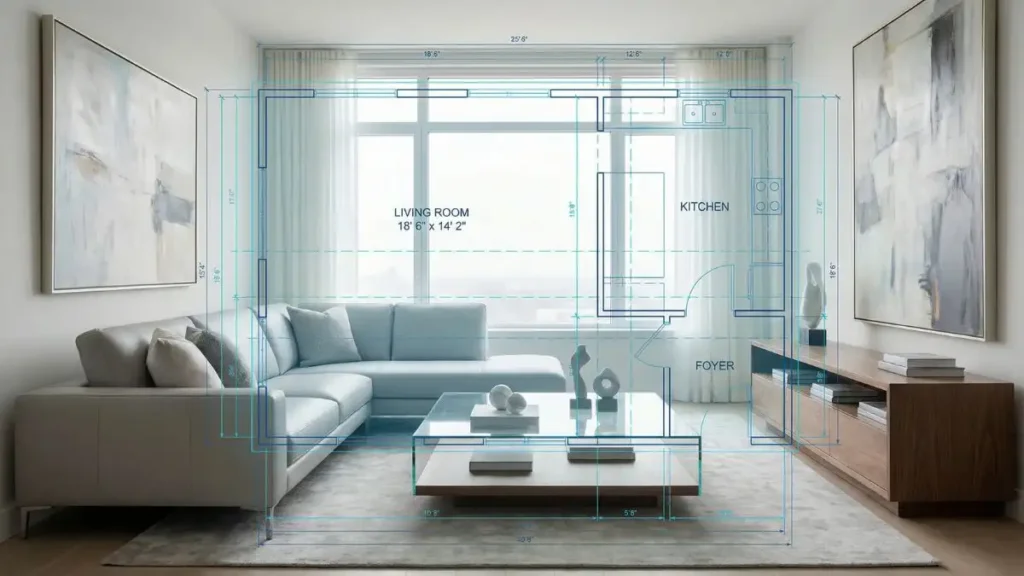
Do not try to measure the whole house at once. Sketch your floor plan and divide every room into simple rectangles. Treat hallways and walk-in closets as their own separate “boxes.”
2. Measure Length x Width
Measure the interior of each room to the nearest inch (or tenth of a foot).
- Formula: Length (ft) × Width (ft) = Area (sq. ft.)
- Example: A bedroom that is 12’ x 14’ = 168 sq. ft.
3. Handle The “Weird” Shapes
- Triangles (Bay Windows): Measure the base and height. Multiply them, then divide by two.
- Complex Rooms: If you have an L-shaped living room, split it into two separate rectangles, calculate them individually, and add them together.
4. What to Exclude
To avoid misleading buyers and getting flagged by appraisers, subtract the following areas:
- Garages
- Unfinished basements
- Porches (even if they are screened-in)
- Guest houses (these are “Accessory Dwelling Units” and are valued separately)
The Bottom Line
Your home’s square footage is more than just a stat on a listing; it is a financial asset. By measuring correctly and understanding the difference between “Total Area” and “Gross Living Area,” you protect your investment.
Ready to list? Grab a laser measure this weekend and see if your home measures up.