
Find your perfect fit and banish discomfort with the CalcGami Bra Size Calculator. Accurately calculate your band and cup size to improve your posture, enhance your silhouette, and shop for lingerie with total confidence.
Your Recommended Size
US / UK
--
Sister Sizes
If the recommended size feels uncomfortable, try these:
--
Looser Band
--
Tighter Band
Table of Contents
What is a Bra Size Calculator?
A Bra Size Calculator is a personal sizing tool designed to help women find their correct lingerie measurements by analyzing the relationship between their ribcage size (Band) and breast volume (Cup).
Studies frequently suggest that up to 80% of women are wearing the wrong bra size. This is often because sizing systems are confusing, vary by region (US, UK, EU, FR), and body shapes change over time due to weight fluctuations, pregnancy, or age. A bra size is not a permanent label; it is a ratio. The number (e.g., 34) represents the band size around your torso, while the letter (e.g., C) represents the difference in inches between the band and the fullest part of the bust. This Bra Size calculator removes the guesswork from the math, converting simple tape measurements into a standardized size code to ensure optimal support and comfort.
Benefits of Using a Bra Size Calculator
Wearing the correct bra size is about more than just aesthetics; it is a matter of health and comfort. Using this tool to find your true size offers several significant benefits:
- Eliminate Discomfort: The right size prevents common annoyances like digging straps, underwires poking into the skin, or bands riding up the back.
- Improved Posture and Health: A supportive bra lifts the weight of the bust off the shoulders and distributes it to the back. This can significantly reduce chronic back pain, neck strain, and shoulder indentations.
- Better Clothing Silhouette: A properly fitted bra lifts the bust to the correct height on the chest, making waists look more defined and causing shirts and dresses to fit smoothly without gaping.
- Online Shopping Confidence: Lingerie is difficult to return. Knowing your accurate measurements allows you to order from online retailers without the fear of the item not fitting.
- Understanding “Sister Sizes”: The Bra Size Calculator tool helps you understand the logic of sizing, which helps you find alternative sizes (Sister Sizes) if your specific size is out of stock (e.g., knowing that a 34C has the same cup volume as a 32D).
Formula Used in Bra Size Calculator
While sizing systems can vary slightly by brand, the calculator uses the standard “Band and Cup Difference” method used by most major lingerie retailers in the US and UK.
Step 1: Determine Band Size
First, we measure the circumference of the ribcage directly under the bust.
- Logic: If the measurement is an even number, that is often the Band Size. If it is an odd number, we usually round up to the next even number.
- Note: Some traditional methods add +4 inches to this number, but modern fitting techniques usually stick closer to the actual ribcage measurement for better support.
Step 2: Determine Cup Size
Next, we measure the circumference of the fullest part of the bust. The Cup Size is determined by the difference between the Bust measurement and the Band measurement.
- Formula: Bust Measurement – Band Size = Difference in Inches.
Step 3: Assign Cup Letter
The difference in inches corresponds to a specific letter:
- 0-1 inch: AA Cup
- 1 inch: A Cup
- 2 inches: B Cup
- 3 inches: C Cup
- 4 inches: D Cup
- 5 inches: DD / E Cup (Depending on region)
- 6 inches: DDD / F Cup
How to Use the Bra Size Calculator
For the most accurate results, you need a soft measuring tape and a mirror. It is best to wear a non-padded, non-push-up bra while measuring so your bust is held in a natural position.
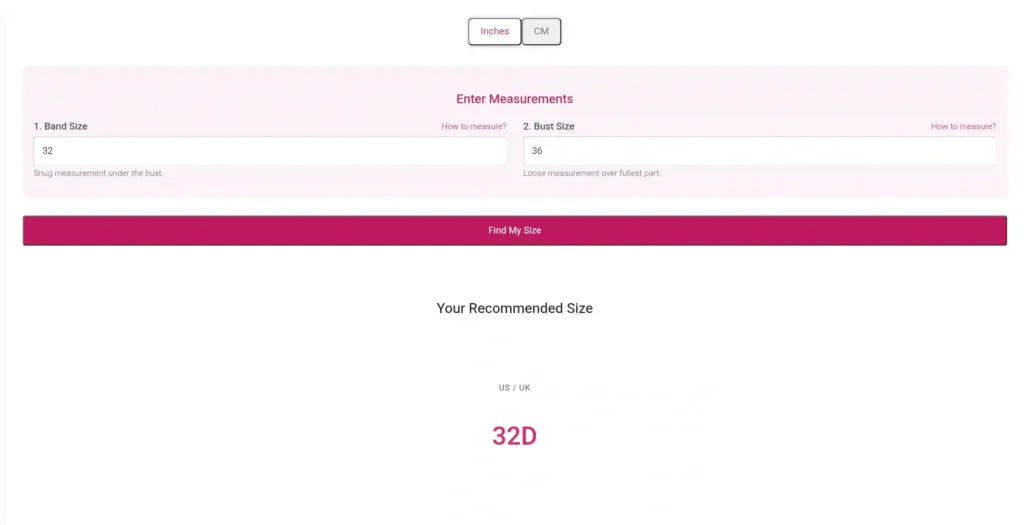
- Measure Band (Underbust): Wrap the measuring tape around your ribcage, directly underneath your bust where the bra band sits. Ensure the tape is level and snug, but not constricting. Enter this value in inches.
- Measure Bust (Overbust): Wrap the measuring tape around the fullest part of your chest (usually at the nipple line). Ensure the tape is straight across your back and not too tight (it should not squash the breast tissue). Enter this value in inches.
- Select Region: Choose your sizing system (e.g., US, UK, EU) as cup letters vary globally after the ‘D’ size.
- Calculate: Click the button to see your results.
- Review Results: The Bra Size Calculator will provide your primary size (e.g., 34C) and often your “Sister Sizes” for better shopping options.
Real-Life Example
Scenario: “Emily” has been wearing a 36B but feels the band is loose and the straps are falling down. She decides to remeasure herself using the Bra Size calculator.
The Measurements:
- Underbust (Ribcage): 31 inches.
- Overbust (Fullest part): 35 inches.
The Calculation:
Step 1: Calculate Band Size
Her underbust is 31 inches. Since band sizes are usually even numbers, we round this to the nearest comfortable even number.
- Band Size: 32 (Rounding up from 31 provides a snug but comfortable fit).
Step 2: Calculate the Difference
We subtract the Band Size from the Bust Measurement.
- Math: 35 inches (Bust) – 32 inches (Band) = 3 inches.
Step 3: Determine Cup Letter
We look at the scale: 1″=A, 2″=B, 3″=C.
A difference of 3 inches corresponds to a C Cup.
The Result:
Emily’s true size is a 32C.
Takeaway: She was wearing a 36B. The 36 band was far too big for her 31-inch ribcage, which is why it felt loose. Moving to a 32 band provides the support she needs, and the C cup ensures the volume is correct.
Frequently Asked Questions (FAQ)
Why does my size vary between different brands?
Just like jeans or shoes, bra sizing is not perfectly consistent across every manufacturer. One brand’s 34C might feel tighter than another’s. The Bra Size calculator gives you a starting point, but you may need to size up or down depending on the fabric and cut of the specific brand.
What is a “Sister Size”?
Sister sizes are bras that have the exact same cup volume but different band sizes. If a 34C fits your cup perfectly but the band is too tight, you would move to the sister size of 36B (go up a band, go down a cup). If the band is too loose, you would go to 32D (go down a band, go up a cup).
How often should I measure my bra size?
You should re-measure yourself at least once every 6 months to a year, or immediately after any significant weight change (gain or loss of 5-10 lbs). Hormonal changes, pregnancy, and aging also affect breast density and shape, requiring a size update.
What are the signs of a wrong fit?
Band rides up: The back of the bra is higher than the front (Band is too big).Spillage: Breast tissue spills over the top or sides of the cup (Cup is too small).Gaping: There is empty space between the cup and the skin (Cup is too big).Red marks: Painful red marks on shoulders (Band is too loose, forcing straps to carry the weight).
Should I measure while braless or wearing a bra?
It is generally recommended to measure while wearing a non-padded, underwire bra that fits you reasonably well. If you measure braless, gravity may affect the “Bust” measurement, resulting in a cup size that is too small. Do not measure while wearing a push-up bra or sports bra, as these artificially change your shape.
What is the difference between US and UK sizing?
Up to a D cup, US and UK sizing are generally the same. However, for larger cup sizes, they diverge.US Progression: D, DD, DDD, G, H.UK Progression: D, DD, E, F, FF, G, GG.Always check which system the brand uses. A US “G” is much smaller than a UK “G”.