
Compare tire sizes, calculate diameter differences, and check speedometer accuracy with the CalcGami.com Tire Size Calculator. Ensure your new tires fit your vehicle safely and performance remains optimized.
Comparison Results
| Measurement | Current Tire | New Tire | Difference |
|---|---|---|---|
| Diameter (Height) | - | - | - |
| Width | - | - | - |
| Sidewall Height | - | - | - |
| Circumference | - | - | - |
| Revs / Mile | - | - | - |
Speedometer Reading
When your speedometer reads 60 mph, you are actually traveling:
0 mph
Table of Contents
What is a Tire Size Calculator?
A Tire Size Calculator is an automotive tool designed to help car owners and mechanics compare the physical dimensions of two different tires, typically the “Stock” tire (what came with the car) and a “New” tire (what you want to install).Tires are identified by a code on their sidewall (e.g., 205/55 R16), which represents a mix of millimeters, percentages, and inches. This mix makes it difficult to mentally visualize the actual size of the tire. A Tire Size Calculator decodes these numbers to calculate the total diameter, sidewall height, and circumference. Crucially, it calculates the percentage difference between the two tires to ensure the new set won’t negatively impact your speedometer accuracy, safety systems, or wheel well clearance.
Benefits of Using a Tire Size Calculator
Changing your tire size is a popular modification, but doing it incorrectly can be dangerous. Using this Tire Size calculator offers several key benefits:
- Safety Assurance: Ensures the new tires are not significantly larger or smaller than the manufacturer’s recommendation, maintaining the effectiveness of ABS and traction control systems.
- Speedometer Accuracy: Changing tire diameter changes how fast your wheels spin. This Tire Size Calculator tool calculates the “Speedometer Error” so you know if you are driving faster or slower than your gauge shows.
- Clearance Check: Helps you determine if a taller or wider tire will fit inside your wheel well without rubbing against the suspension or fenders.
- Performance Insight: Understanding the change in tire diameter helps you predict changes in acceleration (smaller tires accelerate faster) and fuel economy (larger tires often offer better highway mileage).
- Plus-Sizing Guide: Perfect for drivers who want to upgrade to larger rims (e.g., 16-inch to 18-inch) while keeping the overall tire diameter the same.
Formula Used in Tire Size Calculator
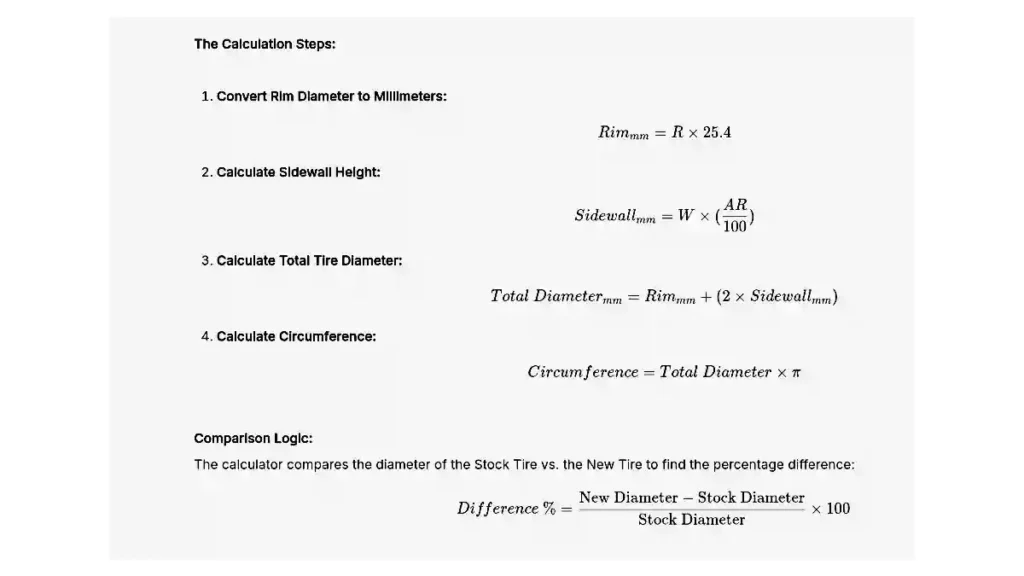
To find the total diameter of a tire, the calculator uses the standard metric tire sizing formula.
The Code Breakdown:
- W (Width): The width of the tire in millimeters (e.g., 205).
- AR (Aspect Ratio): The height of the sidewall as a percentage of the width (e.g., 55%).
- R (Rim Diameter): The diameter of the metal wheel in inches (e.g., 16).
How to Use the Tire Size Calculator
Follow these steps to compare your current tires with a potential upgrade:
- Identify Stock Tire Size: Look at the sidewall of your current tires or your driver’s side door jamb. Note the three numbers (e.g., Width: 205, Ratio: 55, Rim: 16).
- Enter Stock Values: Input these numbers into the “Tire 1” or “Stock” section of the Tire Size Calculator.
- Identify New Tire Size: Choose the size you are considering purchasing.
- Enter New Values: Input these numbers into the “Tire 2” or “New” section.
- Calculate: Click the button to generate the comparison.
- Analyze Results: Look specifically at the Diameter Difference (%).
- Green Zone: Less than 3% difference (Generally safe).
- Red Zone: More than 3% difference (Not recommended as it may cause brake failure or rubbing).
Real-Life Example
Scenario: You have a sedan with standard 16-inch wheels. You want to upgrade to larger 17-inch sports wheels but want to keep the total height of the tire the same so your speedometer stays accurate.
The Specs:
- Stock Tire (Tire A): 205/55 R16
- New Tire (Tire B): 225/45 R17
The Calculation:
1. Tire A (Stock) Diameter:
- Sidewall:
- Rim:
- Total:
2. Tire B (New) Diameter:
- Sidewall:
- Rim:
- Total:
3. The Comparison:
- Difference:
- Percentage: 0.38% difference
Result: This is a perfect fit. The difference is less than 1%, meaning your speedometer will remain accurate, and the tires will fit without rubbing.
Frequently Asked Questions (FAQ)
What is the “3% Rule” in tire sizing?
The 3% rule is a general industry guideline suggesting that the diameter of your new tires should be within 3% of your original stock tires. If the difference is greater than 3%, you risk brake failure (ABS issues) and significant speedometer inaccuracy.
How does tire size affect my speedometer?
Your car measures speed by counting how many times the wheels rotate. If you install larger tires, they cover more ground with each rotation. This means your actual speed will be faster than what the speedometer displays. Conversely, smaller tires mean you are driving slower than displayed.
What does the “Aspect Ratio” (the middle number) mean?
The aspect ratio is the height of the tire’s sidewall expressed as a percentage of its width. For a 205/55 tire, the sidewall height is 55% of 205mm. It is not a measurement in millimeters itself; it is a ratio.
Can I change my rim size without changing my tire diameter?
Yes, this is called “Plus Sizing.” To do this, as you increase the rim size (e.g., from 16 to 18 inches), you must decrease the aspect ratio (the profile) of the tire to compensate. This keeps the outer diameter the same.
Will wider tires use more fuel?
Generally, yes. Wider tires (e.g., going from 205 to 225) have a larger contact patch with the road, which increases rolling resistance and friction. This provides better grip but can slightly reduce fuel economy.
What happens if my new tires are too big?
If you exceed the recommended diameter, the tires may “rub” against the plastic fender liners or suspension components when you turn the steering wheel or go over bumps. This can damage both the tire and the vehicle.